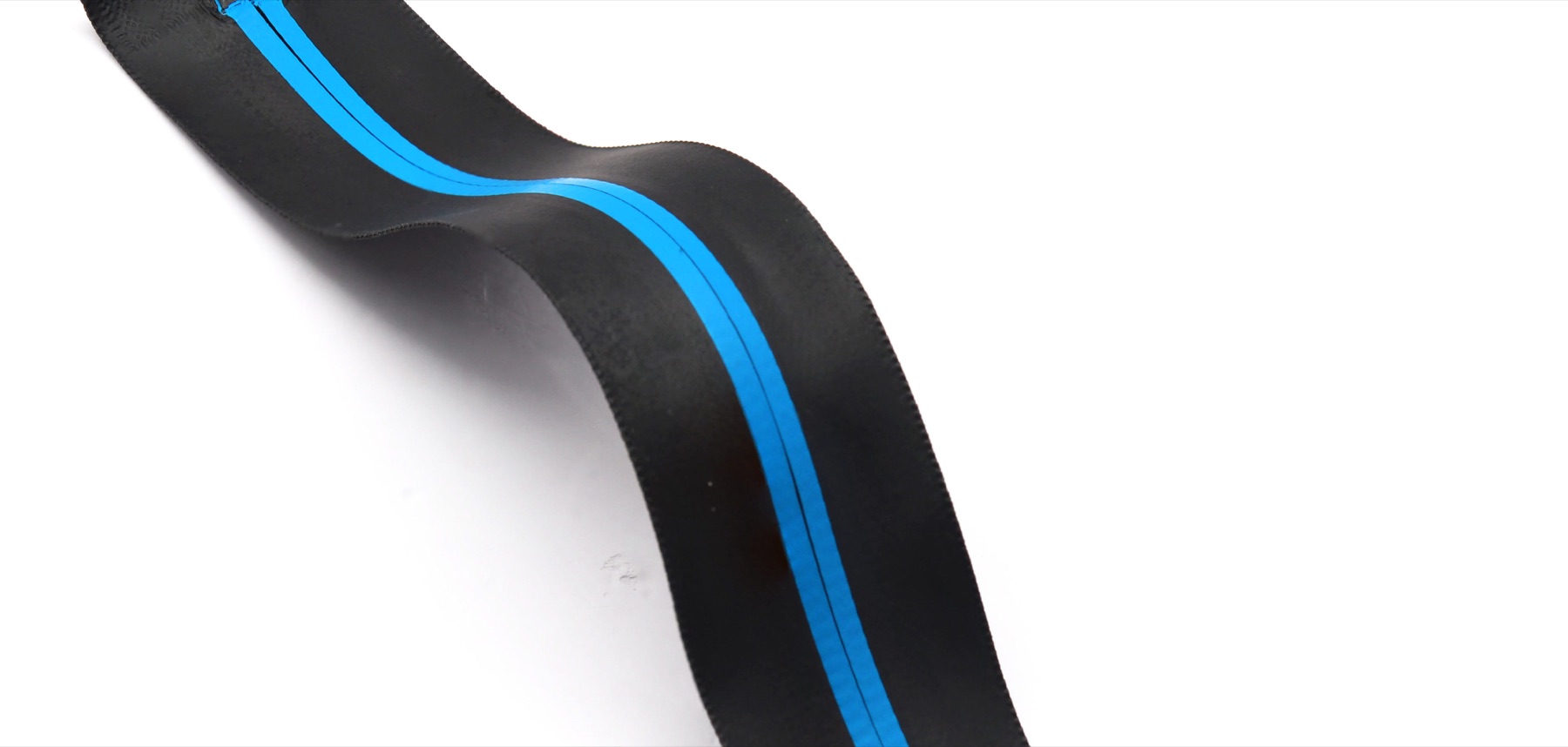
A size 7 center-film water-resistant zipper has a continuous film surface over the central tape area. The film can carry a color that contrasts with the outer tape, creating a visible line along the closure. This construction is useful when a design combines a technical appearance with splash-resistant detailing. The word waterproof in a product name should not be interpreted as a guarantee that a complete garment will remain dry under every condition. Water entry can also occur through teeth, ends, needle holes, fabric, seams, and other garment openings.
Recognizing the Center-Film Construction
Viewed from the front, the central zone is smoother and more continuous than the surrounding woven tape. It may be bright blue against black tape or tonal against navy tape. A colored line alone does not prove that a functional film is present. Examine the surface reflection, hand feel, edge transition, and continuity of the actual sample rather than making a decision from color alone.
With the zipper closed, check whether the two film edges align as intended and whether the teeth sit in the expected position. Flex the chain gently and look for lifting, unusual whitening, or sharp creasing. Operate the slider repeatedly and then inspect its track for scratches or changes in the film. Bonding, tooth engagement, and slider fit all influence the result, so a visually neat sample still needs functional testing.
The film is only one component of the closure. End fittings and the needle line can remain vulnerable even when the central surface looks continuous. A drawing or cross-section is helpful when specifying exactly where stitching is permitted and which surface must remain uninterrupted.
Size 7 and Design Applications
The visual presence of size 7 can suit outerwear, technical-looking bags, and prominent decorative openings. These applications are examples, not universal recommendations. Measure the chain, film zone, tape width, slider profile, and end fittings before deciding the pattern. Also check the minimum curvature expected in the garment, because a film surface can behave differently around a tight bend.
Use an open-end construction where a front opening must separate completely. Use the appropriate closed-end construction for a pocket or another opening that stays joined at one end. Verify the insertion direction and slider orientation as part of the specification, not during bulk sewing.
A colored center film can coordinate with shell fabric, lining, prints, or other trims. Compare it against the real garment materials under relevant lighting. A bright center line on a dark tape creates a strong graphic effect, while a tonal combination is quieter. If washing, low-temperature pressing, or another finish is planned, test whether the process changes film color, gloss, flexibility, or adhesion.
Selection and Sample Validation
- Define the exposure condition: Distinguish everyday splashes from sustained rain or a more demanding seam-sealing requirement.
- Specify the complete construction: Include open-end or closed-end format, slider direction, stops, length, and permitted stitching zones.
- Inspect film continuity: Check edges, bends, and the slider track for lifting, scratches, or abnormal resistance after repeated operation.
- Make a sewn sample: Use the intended needle, thread, stitch density, presser foot, shell, and lining.
- Test the assembled article: Evaluate splash resistance and durability with the actual fabric, seams, and garment design rather than testing the zipper alone.
Sewing, Pressing, and Use
Stitch only in tape areas allowed by the construction. Do not place an unnecessarily dense needle line through a film surface that is intended to remain intact. Avoid stretching the tapes or drawing them together with tight thread tension. Where thin shell fabric meets a wider zipper tape, adjust the pattern or stabilization without obstructing the slider channel. For open-end styles, confirm left-right placement and insertion before stitching.
Test pressing, adhesive bonding, and finishing on a small assembly first. Do not hold a hot iron directly against the film for an extended period. During use, keep the slider path free from lining, loose thread, and dirt. If resistance increases, stop and locate the obstruction instead of pulling harder. Select cleaning methods that are compatible with both the garment and the zipper, and avoid untested solvents or aggressive brushing of the film.
Common Questions
Does a colored center film make the whole garment waterproof
No. Color is an aesthetic feature, and the film is only one part of the zipper. Fabric, seams, needle holes, ends, pockets, and garment openings all affect protection. The complete article must be tested against the intended exposure.
Is a stiffer film necessarily more effective
Stiffness alone is not an effectiveness rating. Excessive stiffness may impair bending and comfort, while flexibility alone does not prove reliable bonding. Evaluate flexing, slider operation, film edges, and the flatness of the sewn assembly together.
How should a mark on the film be handled
First determine whether it is dust, a harmless handling mark, a crease, or surface damage. Do not apply an arbitrary solvent. Repeated scratches along the slider track call for inspection of slider fit, stitch placement, and lining clearance, followed by comparison with an unused reference sample.