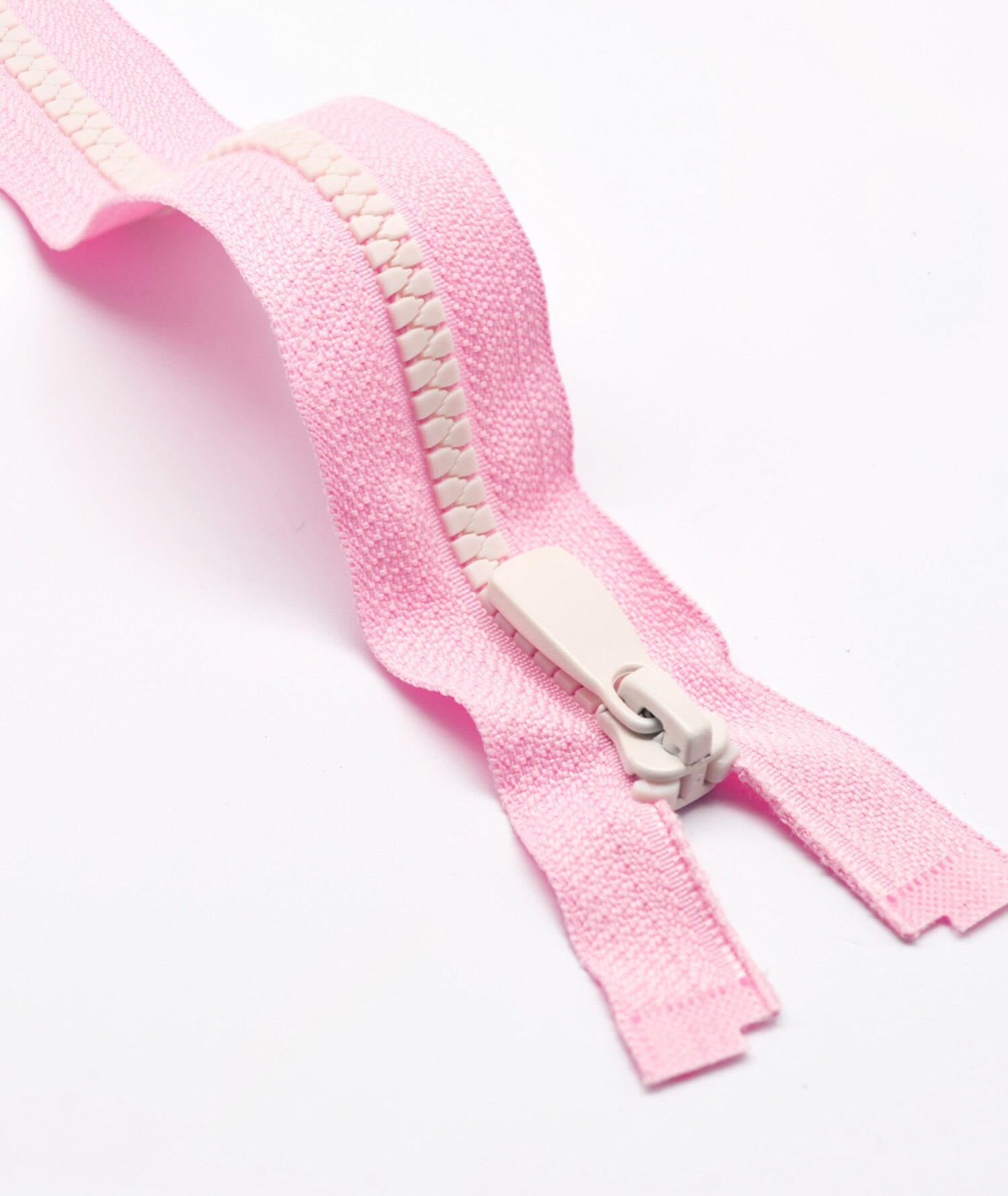
Arching, or puckering, is the wave, bulge, or local unevenness that appears along a zipper opening after sewing, and it is common on curved openings, stretch fabrics, and garments that are washed. It seldom has a single cause; tape shrinkage, chain rigidity, sewing tension, and pressing all contribute. A size 5 anti-arch triangle-tooth plastic zipper aims to reduce this risk by balancing tooth profile, tooth root, and tape behavior, so the zipper follows the curve of the fabric instead of forming a rigid spine across the opening.
Structure and Construction
The triangle tooth has a front profile close to a triangle, narrowing toward the engagement direction, so adjacent teeth produce a continuous folded line when closed. This geometry distributes bending across several teeth and reduces the chance of a single hard point. The thickness of the root where it joins the tape also matters: a root that is too thick lifts the tape after sewing, while one that is too thin may affect tooth stability. Anti-arch designs balance the two and combine them with tooth pitch and tape softness so that the complete zipper follows a curve more readily.
Molding allows the chain to be formed tooth by tooth with controlled color, while the tape provides the sewing base. In the sample, pink tape is combined with white triangle teeth; the tape edges show a slight wave, and the chain is fine and evenly spaced. This shows that anti-arch behavior is not the shape of one tooth but the result of tooth profile, tape, and stitch position together. A zipper that looks flat on the table is not necessarily flat when sewn into a curve, so validation must use an actual garment sample.
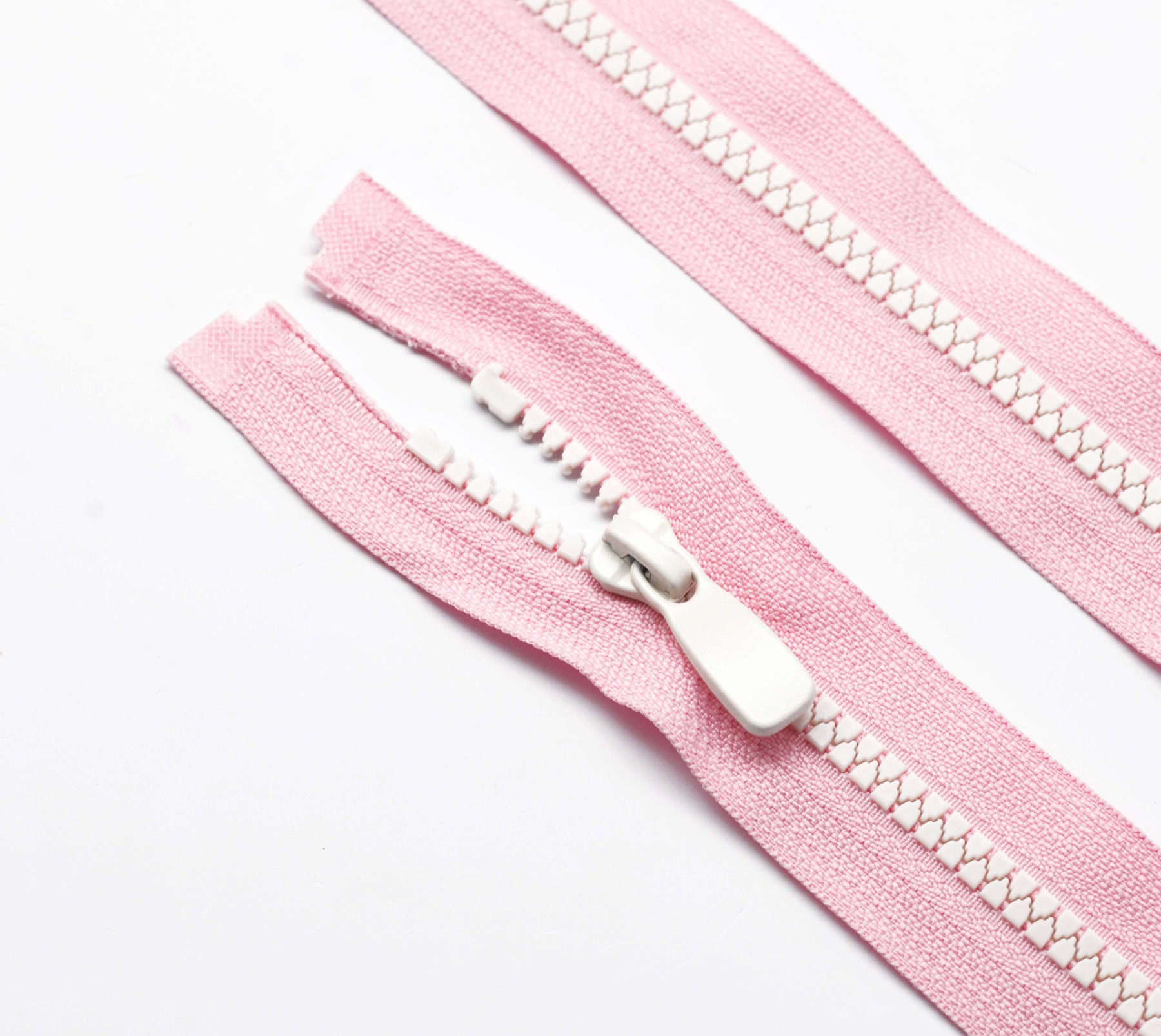
Compared with a standard triangle-tooth product, an anti-arch version emphasizes continuity in bending and recovery after washing. Selection should not rely on a photograph of the tooth alone. Fabric, curve, seam allowance, and washing conditions should all be included in testing, because the same zipper can behave very differently in different garments.
Sizes and Applications
Size 5 is a medium specification suited to medium-weight fabrics and openings that need some strength. Typical uses include center fronts on jackets and workwear, sports outerwear, one-piece garments, skirt side seams, curved bag openings, and garment areas that must remain flat after washing. A curved opening is where the product shows its value most clearly: the chain must bend along the curve without pulling the fabric into a wave.
On very light fabric, size 5 may be visually heavy and can leave a clear impression on the face. On heavy fabric, confirm that seam allowance and slider space are sufficient. For stretch fabrics, pay particular attention to the shrinkage difference between tape and fabric, and control it through pattern compensation and staged sewing where needed. If the opening is almost straight and the fabric is stable, a standard triangle tooth or a basic zipper may be sufficient, and anti-arch construction may add unnecessary cost.
Selection Checklist
- Define the pucker test first: Specify fabric, opening curve, seam allowance, washing method, and observation criteria, and compare samples under the same conditions.
- Check tape and fabric shrinkage: If the difference is too large, even a suitable tooth profile may pucker. Request a trial sewn with the actual fabric.
- Inspect the root transition: Observe whether the join from tooth root to tape is smooth and whether sewing creates a hard edge, especially on the inside of a curve.
- Match slider and ends: The slider channel must pass the triangle teeth, and stops and pins should not create extra bulk at the ends of a curve.
- Keep washed comparison samples: Anti-arch performance often becomes clearer after washing, so retain before-and-after samples for approval.
Sewing and Use Precautions
- Baste or ease a curved opening first so tape and fabric meet in a relaxed state before final stitching, rather than being forced into shape.
- Use a thin, stable presser foot and keep stitch length even. Slow down on the inside of the curve to reduce tape stretching.
- Keep seam allowances equal on both sides and reinforce the start and end, but do not pile thread at the end step.
- Press lightly after sewing to set the shape. Confirm the temperature on a sample of the same construction and avoid pressing directly on triangle teeth or the tape fold.
- If resistance occurs in use, check for trapped fabric and debris before pulling harder. After washing, dry according to care instructions and avoid high-temperature tumble drying.
Common Questions
Can an anti-arch zipper eliminate puckering completely
It cannot be guaranteed. Puckering involves fabric, pattern, sewing, washing, and wearing conditions, and anti-arch construction is only one part of risk reduction. A realistic goal is to keep puckering within an accepted range under agreed conditions and to confirm it through garment testing.
Why does the same zipper pucker on a different fabric
Fabrics differ in shrinkage, elasticity, and thickness, and therefore in how they match the tape. If the fabric shrinks after washing or pressing while the zipper tape shrinks less, the opening is pulled into waves. The usual response is to adjust the pattern, seam allowance, or tape selection.
Is a size 5 anti-arch zipper suitable for light fabric
It can be used on some light fabrics, but the size 5 chain is more visible and can press a hard line. If the design requires a light look, sew a trial with a size 3 or a finer product on the same fabric and compare appearance and hand feel before deciding.