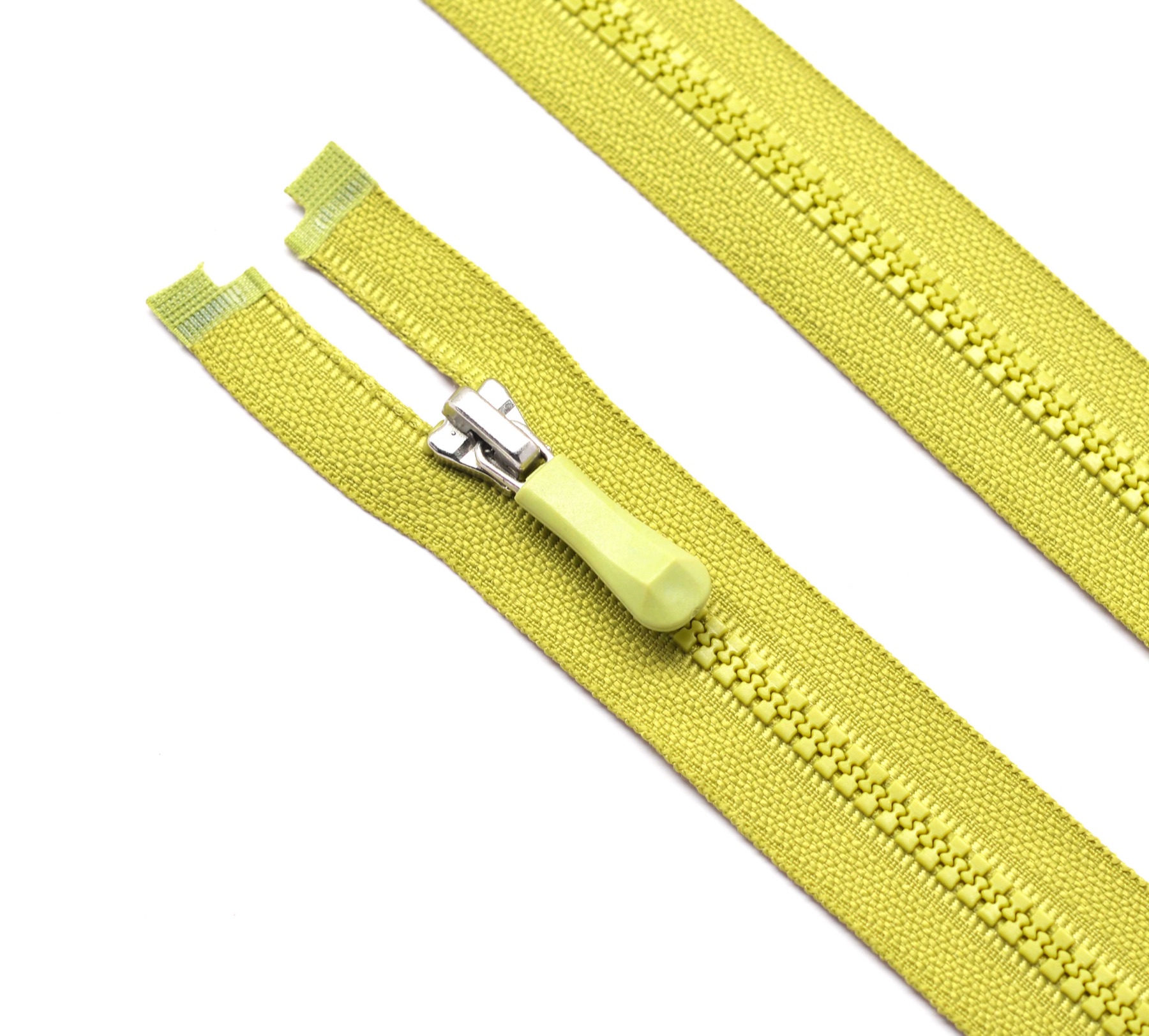
The central difference between an open-end and a closed-end zipper is whether the two sides separate completely when opened. A front closure that must release the left and right garment panels commonly uses a separating construction, while a trouser fly, pocket, or similar localized opening often uses a closed-end construction. Selection should not rely on the application name alone. End fittings, slider count, effective length, handing, and pattern clearance must all be checked; otherwise, the correct tooth type and size can still produce an unusable closure.
Open-End Construction
An open-end zipper has separating components such as a pin and box at one end. To begin closure, the pin must enter the box and slider channel correctly before the slider can engage the two tooth chains. When fully opened, the sides separate, making this construction suitable for jacket fronts, detachable liners, and other openings that must release completely. Two-way or other special arrangements require separate specification of slider positions and operating directions.
The pin and box are functional parts, not merely decorative ends. During sample approval, check insertion, starting action, and whether the joint remains properly engaged during operation. Inspect the tape ends for flatness and distortion as well. Handing must be confirmed on the intended garment; a single photograph cannot reliably show how the parts will face when worn.
Closed-End Construction
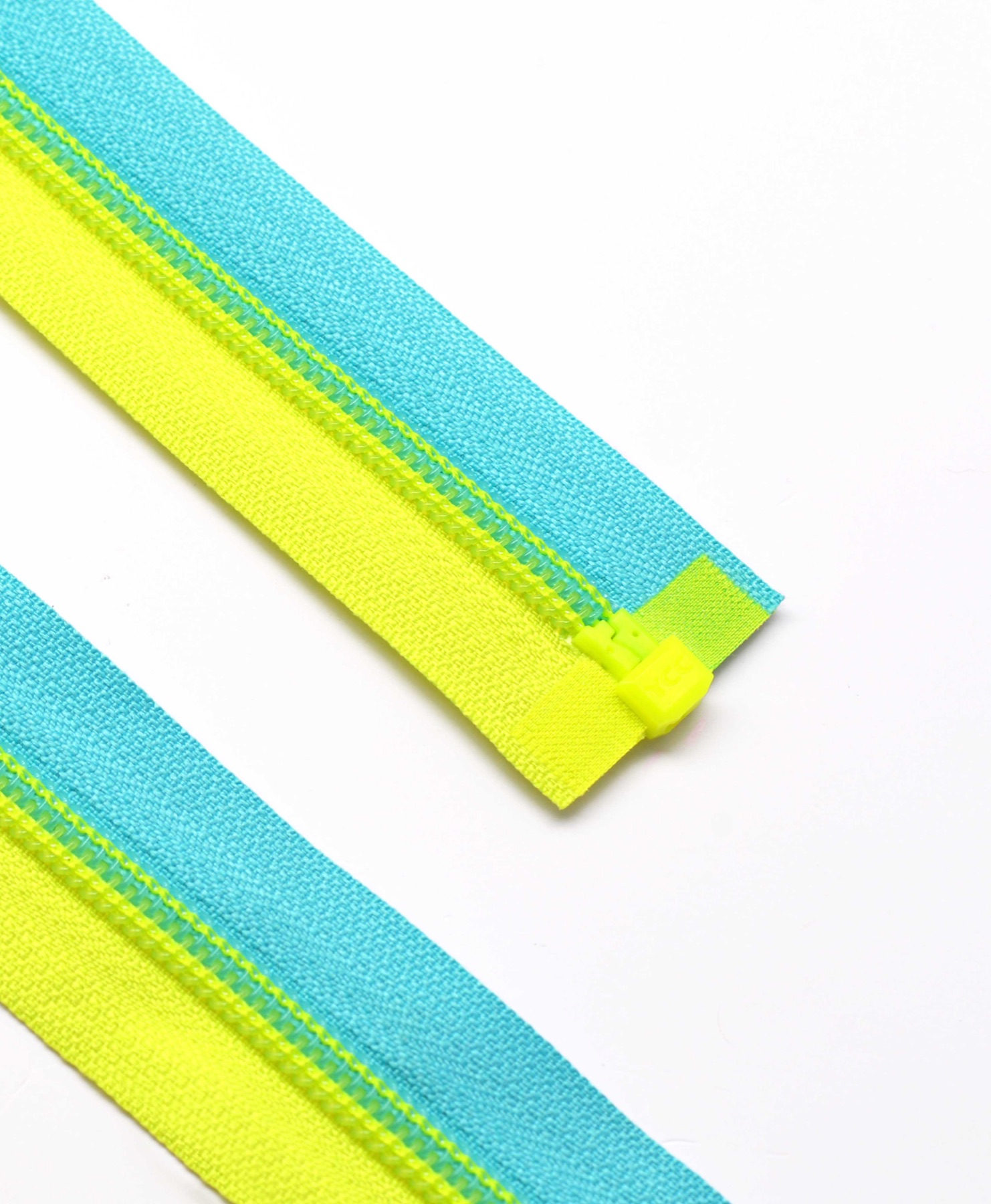
A closed-end zipper keeps the two sides joined at one end through a bottom stop or fixed termination. The slider opens and closes the chain only within a limited range. This suits trouser flies, skirt openings, pockets, and other locations where complete separation is unnecessary. Some closed-end products may use particular top stops, multiple sliders, or special end treatments, so the physical construction still needs approval.
Closed-end does not mean that either end can simply be cut shorter. Length alteration affects stops, slider travel, and the sewing safety area. Any adjustment must follow a suitable process and be followed by an end-security check. If the pattern requires both ends closed or a continuous loop, state that requirement explicitly rather than assuming a standard closed-end zipper will provide it.
Measuring Effective Length
Overall zipper length, tape length, and effective opening length are different measurements. Sampling should define the exact start and end points. A separating zipper requires allowance for the pin-and-box area, while a closed-end zipper requires consideration of stops and accessible slider travel. Setting the pattern opening equal to total tape length can leave insufficient useful travel after the ends are sewn.
- Name the construction: Specify open-end or closed-end rather than relying on an application label such as front zipper.
- Define measurement points: Mark the start and finish on a sample or drawing and distinguish tape length from slider travel.
- Confirm handing: Position the zipper in wearing orientation to verify the pin, box, pull, and face side.
- Allow end clearance: Leave room for stops, end binding, and stitching without crossing functional components.
- Measure the usable opening: Operate the sewn sample and confirm that it supports dressing, access, or detachment as intended.
Sewing and Operating Checks
When sewing a separating zipper, protect the pin, box, and tape ends and keep lining or seam allowances outside the joining channel. After both garment panels are assembled, check their vertical alignment and perform repeated insertion and separation cycles. If insertion requires unusual force, inspect orientation, fitting distortion, and trapped fabric rather than twisting the components harder.
For a closed-end zipper, ensure that stitching, bartacks, and binding do not compress the bottom-stop area or abruptly obstruct the slider. Keep both tapes naturally flat without stretching them to force a smooth placket. For either construction, final approval should include full operation with the actual shell and lining, including curved positions and realistic garment movement.
Common Questions
Is every front zipper an open-end zipper
No. The need for complete separation depends on the design. A decorative placket or pullover style may require only a localized opening and can use a closed-end construction. A front whose left and right panels must separate completely normally requires an open-end zipper.
Can a closed-end zipper be converted by removing the bottom stop
Simply cutting off the stop does not create a functional separating zipper. Open-end construction requires compatible pin, box, and end geometry. Unapproved alteration can impair operation and security, so select the required construction instead.
Does a stuck separating zipper always indicate a tooth problem
Not necessarily. Incomplete pin insertion, incorrect orientation, fabric trapped in the box, damaged fittings, or slider mismatch can all prevent starting. Inspect the end joint and fabric clearance before examining the chain, and avoid immediate forceful pulling.