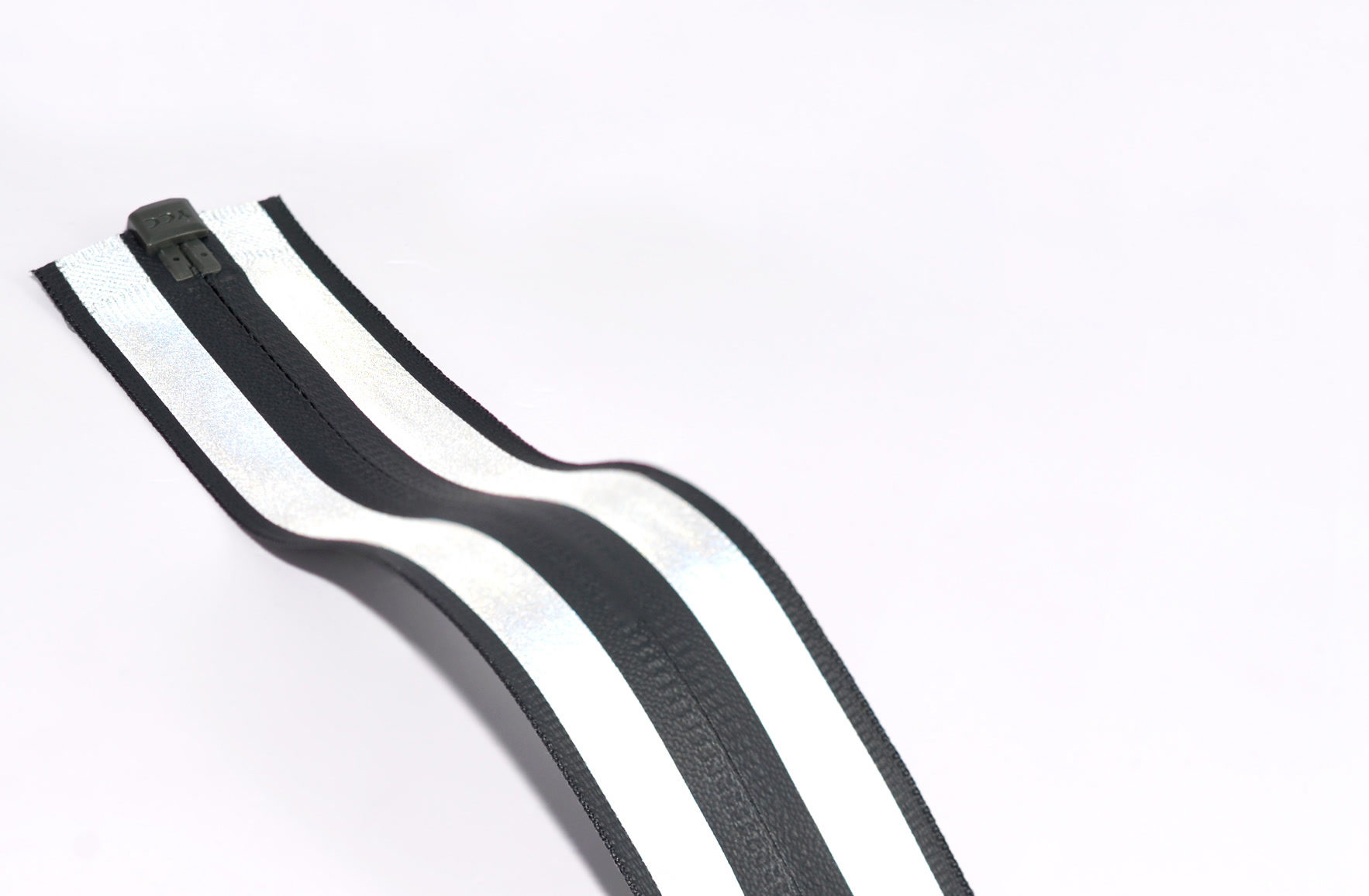
A waterproof reflective zipper combines a smooth film face with banded reflective areas on one tape; this topic concerns size 7. It suits jackets, sports-inspired leisure products, and bags whose designs use both a dark closure line and high-contrast stripes as visual features. However, neither “waterproof” nor “reflective” should be promised independently of the materials, construction, and conditions of use. Water-shedding behavior requires sample validation. The visibility of the reflective areas also depends on the light source, incidence direction, viewing angle, surface cleanliness, and obstruction. These zippers should not automatically be treated as professional safety equipment.
Structure and Process Characteristics
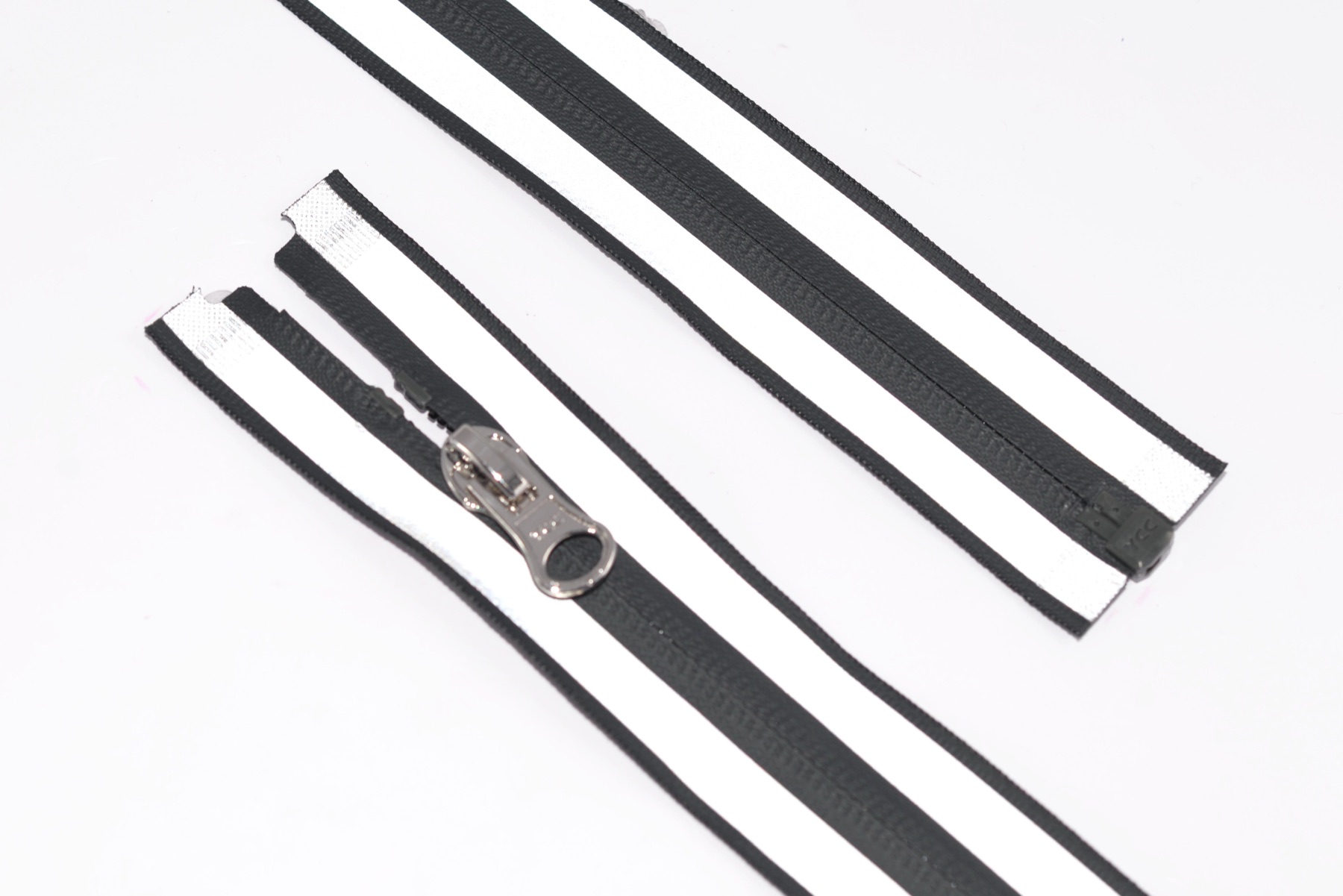
The physical sample shows distinct zones: a dark central closure area and lighter bands on both sides. The central film contributes to surface appearance and the water-shedding design, the lighter areas provide the reflective visual effect, and the elements and slider perform the mechanical action. All these zones must work together on a flexible tape, so evaluating only one feature can miss problems with the complete zipper.
Reflective does not mean self-luminous. The effect depends on external illumination and suitable viewing conditions. Appearance changes with lighting direction, in darkness without a light source, or when a garment panel covers the bands. Approval should therefore include observation of the finished article at realistic positions and angles, with the lighting conditions recorded. A single flash photograph should not be treated as evidence of a constant effect.
Size and Applications
Size 7 suits designs in which the zipper line forms part of the visual composition. Depending on the pattern, it may be considered for casual jackets, sports-style garments, openings on cycling or commuting products, and bags requiring a clearly defined closure boundary. The exact location still requires assessment of fabric thickness, bend radius, operating space, and end construction. Reflective bands primarily provide visual recognition and do not replace any dedicated reflective configuration required by regulations or standards. Products intended for a defined safety use need a separate review of applicable requirements and finished-product testing.
Selection Checklist
- Separate the two requirements: State the water-shedding design objective and reflective visual objective individually instead of using one general “functional” claim for all acceptance criteria.
- Observe band placement: Check the apparent width of the light areas, left-to-right symmetry, distance from the elements, and how much of each band will be covered after sewing.
- Check complete operation: Run the matching slider over the full travel repeatedly, assessing resistance and element engagement when the zipper is flat, curved, and sewn to fabric.
- Plan scenario-based tests: Use appropriately controlled splash or spray exposure, bending, and operating cycles for the intended environment, and record reflective appearance under different lighting and viewing angles.
- Confirm appearance and ends: Document color, film texture, band continuity, open-end or closed-end construction, length, and pull orientation in the approved-sample record.
Sewing and Use Precautions
- Make a sewing sample first. Place stitches in the designated tape area, avoiding the central closure zone, reflective bands, and any location that could obstruct slider travel.
- Control feeding and tension without stretching the tape. Validate natural conformity on curved sections to prevent twisted bands or local waviness that affects appearance.
- Test heat tolerance before ironing or heat pressing. Use a press cloth and protect the film, reflective areas, and slider rather than applying settings used for ordinary webbing.
- Avoid tight folds, abrasion, and contact with rough clamps. Protect the light bands during handling so dirt, dents, or local wear do not alter their visual effect.
- Base cleaning on trials with the actual materials and do not use unverified strong solvents. Dirt can change the reflective appearance; clean gently, dry thoroughly, and inspect again.
Frequently Asked Questions
Do brighter reflective bands mean the whole garment is safer?
That conclusion cannot be drawn directly. Visibility also depends on area, placement, movement, light source, and obstruction. A specific safety application requires assessment of the complete product against the relevant requirements.
Should a waterproof reflective zipper carry a waterproof rating?
A rating should only be considered after applicable testing corresponding to that rating has produced clear results. A film face, product name, or splash photograph alone does not establish a rating.
How should wavy bands after sewing be investigated?
First check whether the tape was stretched and whether both fabric layers fed evenly. Then review stitch length, curved pattern pieces, and presser-foot handling. Do not rely on heavy high-temperature pressing to flatten the bands, as this may affect both the film and reflective areas.